While being interviewed about her experience surviving the Moore, Oklahoma tornado, Rebecca Vitsmun outed herself after Wolf Blitzer incorrectly assumed she had "thanked the lord".
This story is a perfect example of how Christian privilege works in our society. A national reporter thought it was appropriate to just assume a random person was Christian. The fact that she was willing to say on national television that she's actually an atheist resulted in national attention because it's a big deal to be willing to be openly atheist. Even when it shouldn't be.
What Rebecca did was mundane. Or least it should have been. It was anything but mundane, and that's the problem. A lot of atheists are afraid to do this. Even Rebecca was afraid to do it. But it was either that or lie.
Her story has been in the back of my mind during the last week since my encounter with my town's mayor. It's why I wore the shirt with her quote at today's rally at La Vista City Hall.

This shirt exists because people rallied around Rebecca to support her.
What I did should have been mundane. I was a citizen approaching an elected official with a valid concern. But, like Rebecca's situation, what should have been mundane was not. The story went national extremely quickly, starting with The Friendly Atheist and followed by Raw Story, Washington Times, Christian Post, The Blaze, and others.
I know the attention I've had from it, so I can only imagine the focus that's been on Mayor Kindig's office. I've had a lot of atheists (and some believers) thanking for me for what I did. But on its own, what I did was not anything special. It was only special because our culture is constantly telling atheists to shut up and stay hidden, and I refused to do so. Atheists being open about being atheists is seen as a challenge to the Christian privilege that permeates our culture.
Christian privilege is what had La Vista defaulting directly to the event being overtly Christian, rather than secular or inclusive of other religious viewpoints. Christian privilege is what let Mayor Kindig feel safe in dismissing my concerns so hastily.
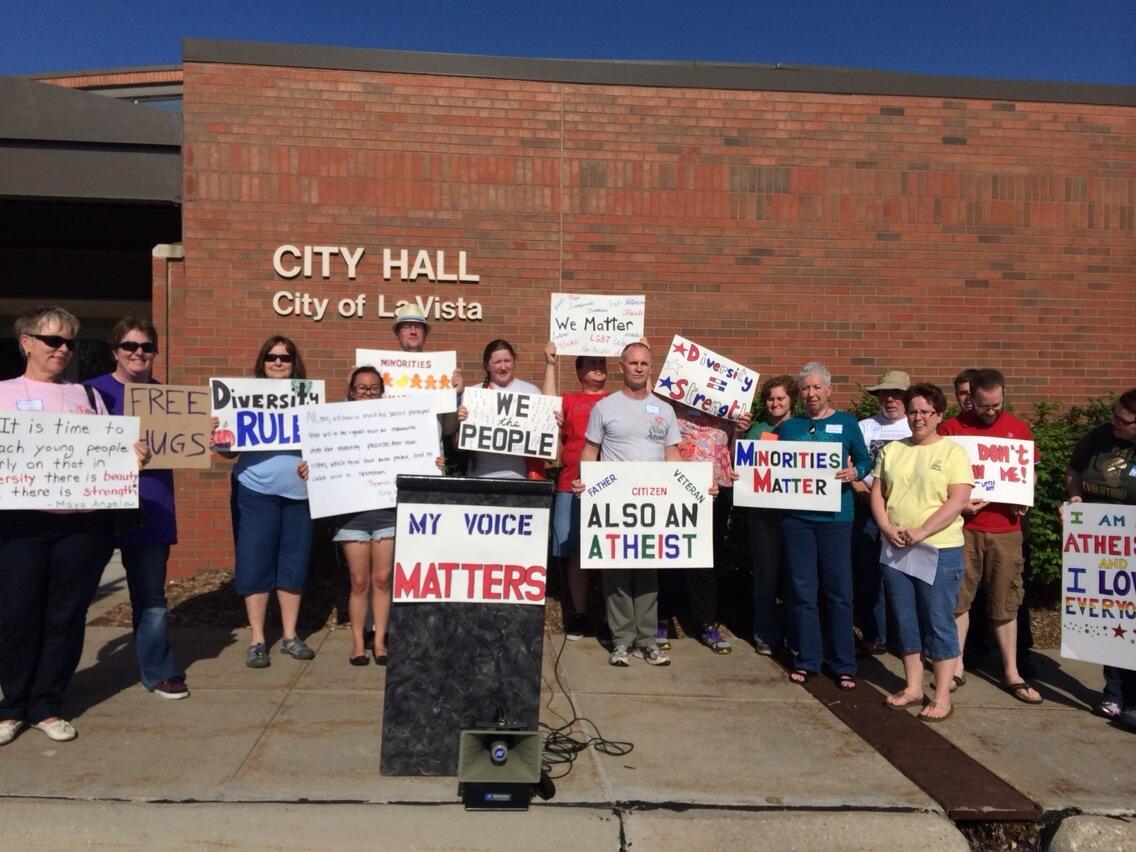
Today's rally was to show that my concerns are not mine alone and that we will not sit idly by while those concerns are dismissed in favor of Christian privilege.
It shows government officials that they're not free to insert their religion into government without someone standing up to them. And it shows atheists that if they are that person standing up, they will not be doing so alone. They will have groups like Omaha Atheists and American Atheists supporting them, just like I've had over the last week.
This story is a perfect example of how Christian privilege works in our society. A national reporter thought it was appropriate to just assume a random person was Christian. The fact that she was willing to say on national television that she's actually an atheist resulted in national attention because it's a big deal to be willing to be openly atheist. Even when it shouldn't be.
What Rebecca did was mundane. Or least it should have been. It was anything but mundane, and that's the problem. A lot of atheists are afraid to do this. Even Rebecca was afraid to do it. But it was either that or lie.
Her story has been in the back of my mind during the last week since my encounter with my town's mayor. It's why I wore the shirt with her quote at today's rally at La Vista City Hall.
This shirt exists because people rallied around Rebecca to support her.
What I did should have been mundane. I was a citizen approaching an elected official with a valid concern. But, like Rebecca's situation, what should have been mundane was not. The story went national extremely quickly, starting with The Friendly Atheist and followed by Raw Story, Washington Times, Christian Post, The Blaze, and others.
I know the attention I've had from it, so I can only imagine the focus that's been on Mayor Kindig's office. I've had a lot of atheists (and some believers) thanking for me for what I did. But on its own, what I did was not anything special. It was only special because our culture is constantly telling atheists to shut up and stay hidden, and I refused to do so. Atheists being open about being atheists is seen as a challenge to the Christian privilege that permeates our culture.
Christian privilege is what had La Vista defaulting directly to the event being overtly Christian, rather than secular or inclusive of other religious viewpoints. Christian privilege is what let Mayor Kindig feel safe in dismissing my concerns so hastily.
Today's rally was to show that my concerns are not mine alone and that we will not sit idly by while those concerns are dismissed in favor of Christian privilege.
 |
| Photo Credit: Amanda Knief |
